


All information, statements and theories in this post are purely our personal feelings and opinions. We try to provide you with interesting content and inspiring topics, as well as interesting and verified knowledge, but we do not always succeed. The Internet is full of fake news therefore, we encourage you to search for information on your own and verify the facts Our goal is first and foremost to entertain, provoke thought, and arouse interest in the topics presented, rather than provide scientific material or analysis. If you have a different opinion from the one you read below, or want to share your thoughts, we encourage you to kindly exchange your opinions constructively in the comments at (link to the podcast)
Welcome. In today’s world where AI, surrounds us from all sides, we don’t think about what benefits or risks artificial intelligence brings. People, were afraid and sometimes still are afraid that the development of artificial intelligence, may translate into their employment, and salary. Today we are just going to touch on the topic, in which we will answer the question “will artificial intelligence replace programmers and other professions?”.
At the outset, it must be clearly established. Everyone has their own view of artificial intelligence, and their own vision of how it will develop. We are unable to say which theory will be correct. Both our and your perceptions of the vision of the future may be wrong.
People just entering the world of programming, and those starting their careers in IT, can feel much more confident these days. Supporting the development process by inputting information as a prompt to AI, and getting an answer, is much better than constantly asking a senior developer, or searching through hundreds of thousands of pages of documentation.
Of course, it makes the work easier however, it is important to remember that AI cannot replace our brains. If you think that by copying and pasting answers from AI, and testing whether something works or not, you can hardly be called a developer. You then lack basic knowledge about what AI is giving you in the first place (is it safe, is it optimal, does it take too many resources, etc.).
Such people may think that either you can “bend” reality, and write in your resume, information that after a 5-minute video on YT is already mid developer of Java.
Unfortunately, it is not as colorful as we think. We should be aware that we may end up in a company or project that will have AI sites blocked. Then if we lied in the hiring process, or thought that our work would help AI, we may be very surprised. Worst of all, they might fire us, and we’d rather not get bad references from the old company.
AI capabilities may persuade young developers to, send resumes to companies that specifically stated some requirements that our candidate does not meet. After all, we have AI at our disposal to help us if we need it.
In the same way, they can urge the recruitment or HR department to make their job easier too. After all, I can throw a thousand resumes into AI, write it additionally who, with what competencies I am looking for, and it will display me, for example, 3 resumes. Well. I already have 3 resumes, now I just need to call these people, invite them to a recruitment interview, and draw up some tests for the recruitment. Again, I’ll throw a prompt into AI to generate me sample recruitment questions. Life gets simpler…
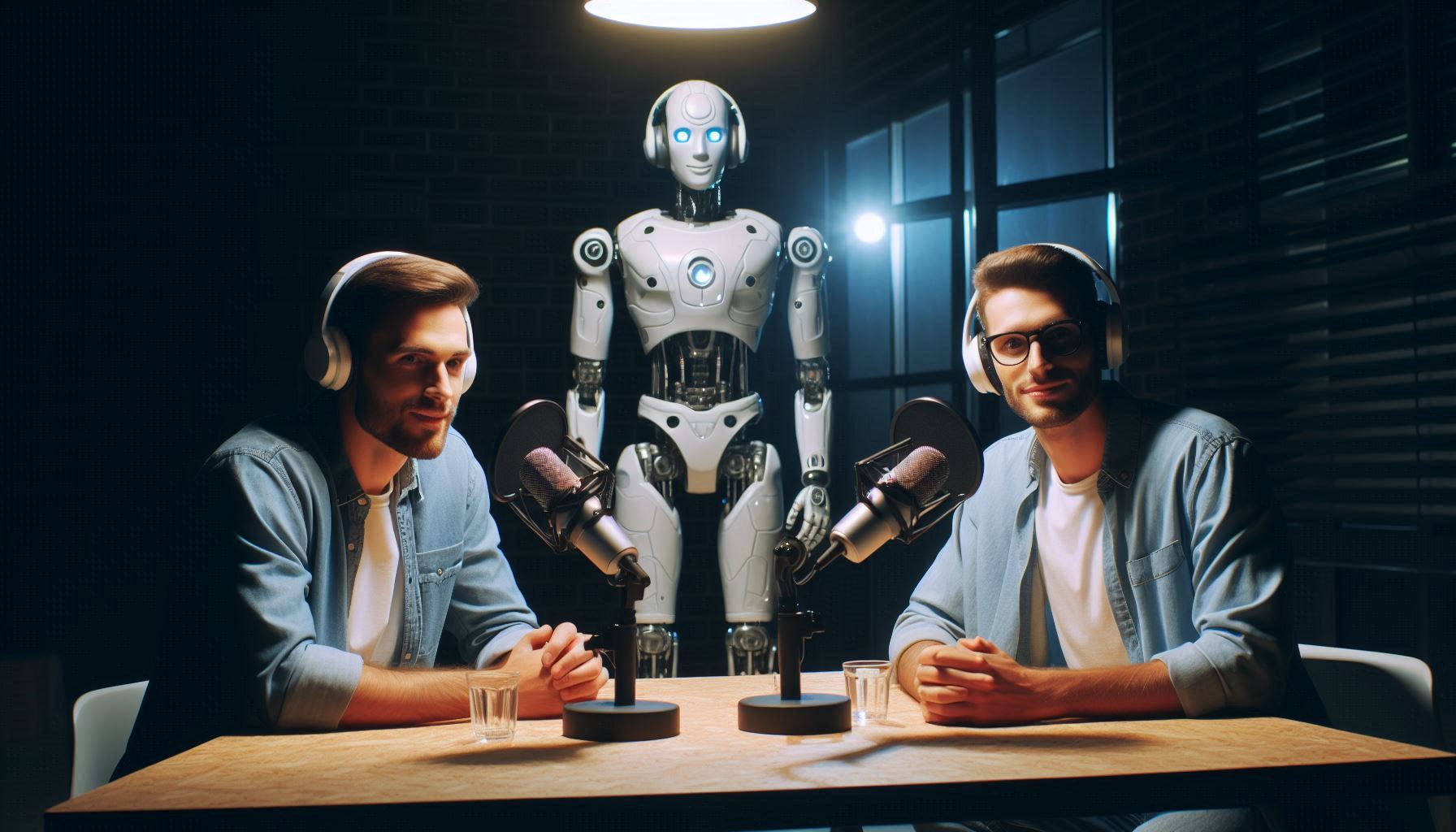
Looking from the perspective of a potential client for a graphic designer, rather today’s times are not easy. For example, instead of commissioning a graphic for our podcast, or a post on Social Media, we can use AI instead of commissioning an image for a graphic designer.
For us, it is so much easier because in a few moments, we are able to get several images from which we can choose what suits us. However, if it does not meet our expectations, we can improve our prompt and repeat the process.
Of course, this is a “drop in the bucket” of companies’ needs, and it is certainly not as good as getting an image, from an experienced graphic designer, although probably quite a few companies, have switched to AI.
Of course, there had to be a sector where you can both earn and can compete with humans. Such a place, for example, is Instagram, and AI-generated models.
Their photos look like, after strong photoshop, so they are recognized by most young people without a problem. The question here is whether older people, not so deeply familiar with technology, will be able to recognize what is reality and what is the work of AI?
What do we have in our minds that the accounts of AI models are viewed by several hundred thousand people each? Why do we like it? Why can these images catch our eye? That’s exactly how these accounts on Instagram can work, too. They test what really “clicks” and do various tests with it. If something after these tests brings more impressions or reactions under the post, we accept this test (consider it successful), and repeat the process again.
Boris Eldagsen, presented a photo/project entitled “The Electrician” at the Sony World Photography Awards. It won the contest, of course, but refused to accept the prize. Why? Because the image, was generated with the help of AI. What does this really mean? It means that the artificial intelligence won a photo contest, but not the first better one, a kindergarten competition for a painting with a tree. We are talking about one of the better photo contests held by Sony.
The “AlphaFold” artificial intelligence developed by “DeepMind,” a subsidiary of “Alphabet” (the parent company of Google), has won the medical Lasker Prize, considered an antechamber to the Nobel Prize. Something that was once very difficult to achieve has been achieved with the help of AI. Looking at it, from the side. Doesn’t that mean that AI can already replace scientists in some aspects?
In the US and Singapore, police robots have been introduced. Of course, as of today, they don’t do as much as we might think. They are not robots from the Terminator movie, but if combined with facial recognition capabilities, or if we would add, for example, a stun gun (which may be a matter of time), it is a thought-provoking point of view.
If you think that it won’t be a problem after all, think about the fact that in China, for example, it’s no longer just cameras embedded in stationary devices that will monitor citizens, but also robots that could roam the streets that are too dangerous to send humans there. This is somewhat reminiscent of a scene straight out of Watch Dogs game.
BostonDynamics robots, dubbed “BigDog,” are already being used in the military today. We are not in a position to confirm this, but it is rumored that robo-dogs are already being tested in weaponized versions (we recommend looking for the information yourself and assessing its authenticity). Even if, these robots, are not armed is it so problematic to change that? After all, the basis of the mechanisms we already have in robots, which in have connected flame throwers (thermonator robot dog).